

StudyHQ.net will teach you how Facebook Marketplace paid ads work, how to boost listings, set a budget, target buyers, measure results and improve sales during the course of this online guide. So just follow all the steps and instructions in this article for everything you need to know about facebook marketplace ads.
Selling on Facebook Marketplace can be frustrating when you have a good product, competitive price and attractive photos, but very few people see your listing.
That is where Facebook Marketplace paid ads can become useful. Instead of relying entirely on organic exposure, sellers can use paid advertising options to put products in front of additional potential buyers.
However, paying for advertising does not automatically mean more sales.
A poorly presented product can still perform badly. An unrealistic price can still turn buyers away. A weak description can still create uncertainty. And spending money without tracking the results can quickly turn advertising into an unnecessary expense.
This guide explains how Facebook Marketplace paid ads work, how to advertise products, how to boost a Marketplace listing, how much paid promotion can cost, how to choose a budget, how to target buyers, how to measure profitability and what to do when your ads are rejected or the Boost option is unavailable.
Because Meta regularly changes its advertising interfaces and available features, some account-level options can differ by country, account, campaign objective, product and eligibility. Treat the exact buttons and settings you see in your account as the current version of the platform.
Facebook Marketplace Paid Ads
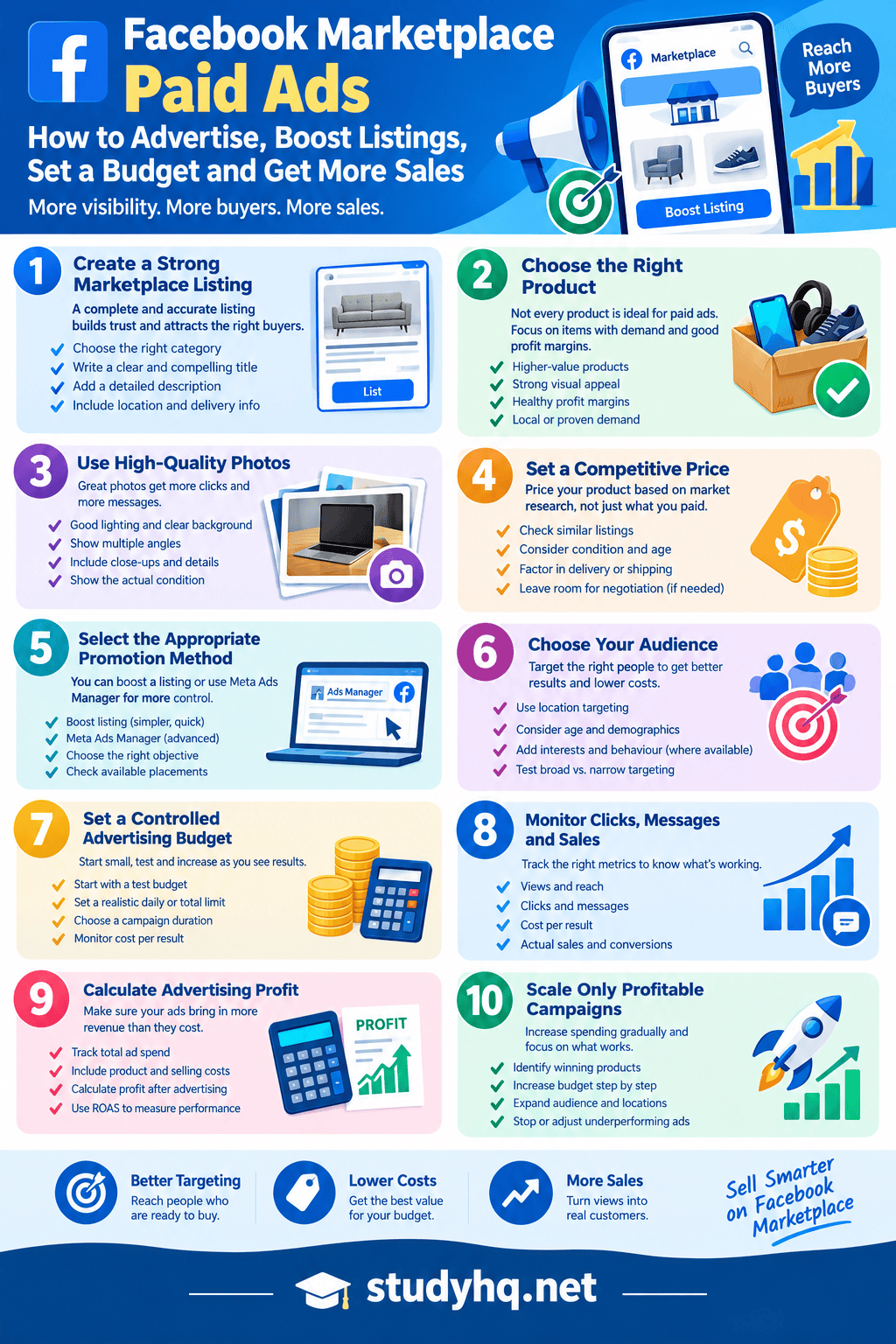
Facebook Marketplace Paid Ads: How to Advertise, Boost Listings, Set a Budget and Get More Sales
- Create a strong Marketplace listing
- Choose the right product
- Use high-quality photos
- Set a competitive price
- Select the appropriate promotion method
- Choose your audience
- Set a controlled advertising budget
- Monitor clicks, messages and sales
- Calculate advertising profit
- Scale only profitable campaigns
What Are Facebook Marketplace Paid Ads?
Facebook Marketplace paid ads are paid promotional activities designed to give a product or offer additional exposure to potential buyers through Meta’s advertising ecosystem.
There is an important distinction between simply creating a Marketplace listing and paying to advertise.
A normal Marketplace listing can be created without buying advertising exposure. Paid promotion involves spending an advertising budget to reach additional people or pursue a particular advertising objective.
Facebook itself describes Marketplace as one of several places where people can sell items on Facebook, alongside buy and sell groups and Shops on Facebook Pages. The exact selling and shipping options available can depend on where the seller is located.
Facebook Marketplace ads explained
There are several concepts that are often confused:
- Organic Marketplace listings
- Promoted or boosted listings
- Ads created through Meta Ads Manager
- Ads delivered across eligible Meta placements
- Advertising campaigns designed to drive sales, leads, traffic or messages
For a beginner, the simplest way to think about paid Marketplace promotion is:
Product → Marketplace listing → Paid promotion → Additional exposure → Buyer interest → Conversation or purchase
The important point is that advertising creates an opportunity to reach buyers. It does not create demand for a product that nobody wants.
Organic Marketplace listings vs paid promotion
An organic listing depends on the normal Marketplace experience and whatever exposure the platform provides.
Paid advertising introduces an advertising budget into the equation.
This means a seller can potentially increase exposure without waiting entirely for organic discovery.
However, the seller still needs:
- A desirable product
- Accurate information
- Competitive pricing
- Good photography
- A trustworthy listing
- A clear buying process
- Fast and professional communication
Are Facebook Marketplace ads different from regular Facebook ads?
They can be.
Meta’s advertising system is broader than Marketplace. Campaigns can involve different Facebook, Instagram, Messenger and other eligible placements depending on the campaign configuration.
Meta also offers placement choices through Ads Manager. For example, its current advertising documentation explains that advertisers can use Advantage+ placements or select eligible placements manually for certain campaigns.
This is why sellers should not assume that every Facebook ad is automatically a Marketplace ad.
The exact placement options available to you should be checked inside your current Ads Manager setup.
How Facebook Marketplace Paid Advertising Works
When you pay to promote a product, several things happen behind the scenes.
Your campaign is submitted for delivery and may go through Meta’s ad review process. Meta says its review system examines components such as ad images, video, text, targeting information and the destination associated with an advertisement.
After approval, the advertising system determines where and when the advertisement can be delivered based on the campaign setup and auction or delivery system.
What happens after you pay to promote a listing?
A simplified process looks like this:
- You create or select a product.
- You prepare the listing or advertisement.
- You choose an advertising objective where available.
- You define audience and budget settings.
- The advertisement goes through review.
- Meta determines eligible delivery opportunities.
- The advertisement reaches potential buyers.
- You monitor interactions and conversions.
- You adjust or stop the campaign based on performance.
The actual interface can differ from one account to another.
How does Facebook decide who sees an ad?
Advertising delivery can depend on multiple factors.
These may include:
- Audience settings
- Location
- Campaign objective
- Available inventory
- Competition
- Budget
- Ad quality
- Expected value to the user
- User behaviour
- Delivery optimization
Meta describes its advertising system as an auction in which ads are delivered dynamically according to factors including advertiser targeting settings and the value an advertisement provides to the user.
This is one reason why simply increasing your budget does not guarantee a proportional increase in sales.
Does paying guarantee that your item will sell?
No.
Paid reach does not equal guaranteed sales.
Imagine you are selling a used sofa in London.
You spend money promoting the listing and receive thousands of impressions. However, your asking price is significantly higher than similar sofas, the photographs are dark and the description does not mention the dimensions.
The campaign may generate exposure without producing a profitable sale.
The same problem can happen with:
- Cars
- Phones
- Furniture
- Electronics
- Appliances
- Clothing
- Fitness equipment
- Collectibles
Advertising can amplify a strong offer, but it can also expose weaknesses in a listing.
How to Create a Facebook Marketplace Listing Before Running Paid Ads
Before spending money, make the listing as strong as possible.
This is one of the most important principles in Facebook Marketplace advertising.
Choose the correct category
Use the most accurate category available for the product.
A buyer searching for furniture should not have to guess whether your listing is actually a sofa, dining table or office chair.
Accurate categorization can also help create a better buying experience.
Write a buyer-focused title
Your title should quickly communicate:
- What the product is
- The important model or type
- Relevant condition information
- A useful differentiating feature
For example:
2023 Apple MacBook Air M2 13-inch, Excellent Condition
is more useful than:
Amazing Laptop For Sale
Avoid stuffing the title with unnecessary promotional language.
Use high-quality product photos
Your first image is particularly important because it can influence whether someone stops to inspect the listing.
Use:
- Good lighting
- Clear backgrounds
- Multiple angles
- Close-up images
- Condition photos
- Images of accessories
- Images showing relevant defects
- Dimensions where useful
Never use photographs that make the product appear significantly different from what the buyer will actually receive.
Write a detailed description
A useful Marketplace description should answer common questions before the buyer asks them.
Depending on the product, include:
- Brand
- Model
- Age
- Condition
- Dimensions
- Colour
- Features
- Included accessories
- Known defects
- Pickup information
- Delivery information
- Payment expectations
Set a competitive price
Research comparable products before setting your asking price.
Look at:
- Similar models
- Condition
- Age
- Location
- Included accessories
- Seller reputation
- Recent comparable listings
Do not automatically choose the lowest price.
The goal is to understand the market rather than simply undercut everyone else.
Add an accurate location
Location is particularly important for products that buyers are expected to collect in person.
A buyer interested in a large piece of furniture may care more about distance than someone purchasing a small item that can be shipped.
Clearly explain pickup or delivery
If the product is pickup only, say so.
If delivery is available, explain the general arrangement and any relevant cost.
Reducing uncertainty can make buyer conversations much easier.
How to Boost a Facebook Marketplace Listing
One of the most valuable searches around this topic is how to boost a Facebook Marketplace listing.
The exact interface can change, so use the current options shown in your account.
A typical workflow may involve the following steps.
Step 1: Create or open your Marketplace listing
Make sure the product listing is complete before considering paid promotion.
Step 2: Go to Your Listings
Open the area where your active Marketplace listings are managed.
Step 3: Select the product
Choose the listing you want to promote.
Step 4: Look for the available promotion option
Depending on your account and listing eligibility, you may see an option related to promotion or boosting.
If you do not see it, do not assume that the feature is permanently unavailable. Eligibility, product type, account status, market and interface changes can affect available options.
Step 5: Choose the advertising goal
Depending on the current setup, you may encounter objectives or optimization choices related to:
- Views
- Messages
- Traffic
- Leads
- Sales
Choose the option that matches what you actually want.
If your primary goal is to sell a product, measuring only impressions is not enough.
Step 6: Select your audience
Your audience should make sense for the product.
A local sofa listing may need a geographically relevant audience.
A product that can be shipped may support a broader approach.
Step 7: Set your budget
Choose an amount you can afford to test without putting the profitability of the business at risk.
Step 8: Select the campaign duration
A short test can help you gather initial performance information before committing more money.
Step 9: Review payment information
Make sure your billing details are correct before submitting the promotion.
Step 10: Submit the promotion for review
Meta reviews advertisements against its advertising standards before or during delivery. Meta says most ads are typically reviewed within 24 hours, although some reviews can take longer. Ads can also be reviewed again after they begin running.
Facebook Marketplace paid ads quick-start checklist
Before promoting a listing, check:
- Product photos are clear
- Price is competitive
- Description is complete
- Location is accurate
- Product is eligible
- Budget is affordable
- Objective matches your goal
- Payment information is correct
- You understand what result you are measuring
How to Advertise on Facebook Marketplace Using Meta Ads Manager
For sellers who want more campaign control, Meta Ads Manager can be more useful than relying only on a simple promotion option.
What is Meta Ads Manager?
Meta Ads Manager is Meta’s advertising management environment for creating, managing and measuring advertising campaigns.
It allows advertisers to work with campaign objectives, audiences, budgets, placements, creative assets and performance data.
When should you use Ads Manager instead of simply boosting a listing?
The answer depends on your advertising needs.
A simple promotion may be appropriate when you want to test one existing product without building a complicated campaign structure.
Ads Manager becomes more relevant when you need more control over:
- Campaign objectives
- Audiences
- Placements
- Budget
- Scheduling
- Creative
- Measurement
- Testing
- Scaling
Choose the right campaign objective
Your objective should reflect the business outcome you care about.
Possible objectives and optimization options can include goals related to:
- Sales
- Traffic
- Leads
- Engagement
- Messaging
The options available can change as Meta updates Ads Manager.
Do not choose an objective simply because it sounds impressive.
Choose the objective that is closest to the action that creates value for your business.
Create the campaign
Start with the business outcome.
Ask:
What do I actually want this advertising campaign to accomplish?
If you sell products, the ultimate goal may be purchases.
If you need buyer conversations before completing a sale, messages may be more useful.
If you are sending shoppers to an online store, traffic or sales may be more relevant depending on your setup.
Configure the ad set
This is where important campaign settings are determined.
These can include:
- Audience
- Location
- Budget
- Schedule
- Placements
- Optimization
Meta’s current advertising ecosystem also includes automated placement options designed to distribute ads across eligible placements according to campaign goals and delivery systems.
Create the ad
Your advertisement may include:
- Primary text
- Headline
- Image
- Video
- Call-to-action
The creative should match the product being advertised.
A furniture advertisement should show the actual furniture clearly.
An electronics advertisement should show the relevant device and its condition.
Avoid using misleading images.
Review and publish
Before publishing, review:
- Product
- Price
- Copy
- Creative
- Audience
- Destination
- Budget
- Tracking
- Policy compliance
Check whether Marketplace is available as a placement
Do not assume Marketplace will appear as an available placement for every campaign.
Meta’s advertising tools are continuously updated, and placements depend on campaign setup, objective, format and eligibility.
Always check the current placement options displayed in your Ads Manager account.
Facebook Marketplace Paid Ads vs Boosting a Listing
These two approaches are related but should not automatically be treated as identical.
| Factor | Boosting or Promoting a Listing | Meta Ads Manager |
|---|---|---|
| Setup | Generally simpler | More advanced |
| Beginner friendly | Usually easier | Requires more learning |
| Existing listing | Central to the process | Depends on campaign setup |
| Targeting | May offer simpler controls | More campaign controls |
| Reporting | Depends on current setup | More detailed campaign reporting |
| Testing | Simpler | More flexible |
| Scaling | Can be limited | Better suited to structured scaling |
| Best suited for | Simple product promotion | Businesses and advanced campaigns |
Which option should a beginner start with?
A beginner who wants to test one product may prefer the simplest eligible promotion method available.
The important thing is not the complexity of the advertising dashboard.
It is whether the campaign can produce useful information about the product.
If you cannot determine whether your advertising generated valuable buyer activity, more advanced settings will not necessarily solve the problem.
Which option is better for an established business?
An established business may benefit from the additional campaign structure available through Ads Manager, particularly when it needs to manage multiple products, audiences, creatives or objectives.
Can you use both?
Potentially, depending on your campaign structure and current Meta options.
However, avoid paying twice to reach essentially the same audience without a clear reason.
How Much Do Facebook Marketplace Paid Ads Cost?
Facebook Marketplace ads cost is one of the most important questions sellers ask before advertising.
There is no single universal price that applies to every Marketplace advertiser.
Your actual cost can depend on factors including:
- Market
- Audience
- Competition
- Campaign objective
- Placement
- Product category
- Budget
- Ad quality
- Demand
- Account setup
- Duration
That means articles claiming that every Facebook Marketplace advertiser pays exactly a particular amount per day can be misleading.
Is Facebook Marketplace free?
Creating a standard Marketplace listing and paying for advertising are two different things.
A seller may be able to create a listing without purchasing advertising.
Paid promotion requires an advertising budget.
Other selling-related fees can also apply depending on the selling method and location.
How much does it cost to boost a Facebook Marketplace listing?
The exact cost depends on the options Meta makes available to your account.
Rather than relying on a universal figure, check the amount presented in your current promotion setup before confirming the campaign.
Facebook Marketplace advertising budget examples
The following are illustrative testing budgets, not official Meta pricing.
Small test
- $5 per day
- 3 days
- One product
Potential test spend: $15
Moderate test
- $10 per day
- 5 days
- One or two creative approaches
Potential test spend: $50
Larger test
- $20 to $50 per day
- Longer testing period
- More structured measurement
Potential spend will depend on the number of days.
The purpose of these examples is to demonstrate budgeting logic, not to claim that Meta requires these amounts.
What affects Facebook Marketplace ad costs?
Advertising costs can be influenced by:
Competition: More advertisers competing for relevant audiences can affect delivery costs.
Audience size: A very narrow audience may behave differently from a broad audience.
Location: Advertising conditions differ across markets.
Product demand: Highly relevant products may attract stronger responses.
Campaign objective: Different objectives can optimize delivery toward different actions.
Creative quality: The quality and relevance of your advertisement can influence performance.
Conversion rate: An advertisement that generates buyers efficiently can be economically stronger even if its raw cost per impression is not the lowest.
Seasonality: Demand for certain products can change during holidays, weather changes, school seasons, sporting events and other periods.
How to Set a Facebook Marketplace Ads Budget
Do not begin with the question:
“How much can I spend?”
Start with:
“How much can I afford to spend while still making a profit?”
Start with a small test budget
A controlled test gives you an opportunity to learn without immediately committing a large amount of money.
You can measure:
- Reach
- Clicks
- Messages
- Buyer questions
- Leads
- Purchases
- Cost per result
- Profit
Calculate your maximum acceptable advertising cost
A useful starting formula is:
Maximum acceptable ad cost = Profit per sale × acceptable advertising percentage
Suppose a product generates $100 in profit before advertising.
If you are willing to allocate 25% of that profit to advertising:
$100 × 25% = $25
Your initial maximum advertising allowance would be $25 per sale under this example.
This is not a Meta pricing rule.
It is a business budgeting method.
Calculate your break-even point
Suppose:
- Selling price = $250
- Product cost = $140
- Other costs = $20
Your profit before advertising is:
$250 − $140 − $20 = $90
If you spend $30 on advertising to produce the sale:
$90 − $30 = $60
You still have $60 before considering any additional costs not included in the example.
When should you increase your budget?
Consider increasing spending when:
- The product is converting
- Advertising cost is sustainable
- Buyer demand is real
- Profit remains healthy
- You have enough performance data
- The campaign can handle additional spending
When should you stop spending?
Consider stopping when:
- Costs continue rising without meaningful results
- Buyers show little interest
- The product has weak demand
- Your profit margin is too small
- The listing needs improvement
- The campaign is producing activity without profitable conversions
Why increasing the budget does not automatically increase profit
A seller might double advertising spend from $20 to $40 and expect sales to double.
That may not happen.
More budget can produce additional exposure, but additional exposure is valuable only when it produces profitable customer actions.
How to Target Buyers With Facebook Marketplace Paid Ads
Targeting should start with the product rather than the advertiser’s personal assumptions.
Location targeting
Location is particularly important for:
- Furniture
- Vehicles
- Appliances
- Large equipment
- Pickup-only products
- Local services
For example, a seller advertising a large dining table may want to focus on buyers within a reasonable driving distance.
A seller offering a small product with shipping may have a different geographic strategy.
Age and demographics
Some products naturally appeal to particular demographic groups.
However, do not create unnecessarily narrow audiences without evidence that the restriction improves performance.
Interest and behaviour targeting where available
Depending on the current Meta advertising setup, interest and other audience controls may be available.
Use relevant signals rather than adding dozens of unrelated interests.
Broad vs narrow targeting
A narrow audience is not automatically better.
Broad targeting is not automatically better either.
The correct approach depends on:
- Product
- Location
- Demand
- Objective
- Available audience
- Campaign data
Local vs national advertising
A local product may need local targeting.
A shippable product may support a broader market.
Consider the actual buying journey.
If the buyer must collect a six-seat sofa from Manchester, advertising it to someone in Edinburgh may create impressions without realistic purchase opportunities.
Tier-1 market examples
For a business serving eligible audiences, useful markets to consider include:
- United States
- United Kingdom
- Canada
- Australia
- New Zealand
- Other established advertising markets
The right country is determined by where the product can actually be sold and delivered.
Best Products to Promote With Facebook Marketplace Paid Ads
Not every product deserves the same advertising strategy.
Higher-value products
Products with greater transaction values can sometimes provide more room for advertising costs.
Examples include:
- Furniture
- Electronics
- Vehicles
- Home appliances
- Collectibles
- Premium fashion
- Fitness equipment
This does not mean expensive products automatically perform better.
It simply means the potential profit per transaction may provide more room to absorb advertising costs.
Products with strong visual appeal
Facebook Marketplace is naturally suited to products where buyers can understand the offer quickly through images.
Examples include:
- Furniture
- Cars
- Fashion
- Home décor
- Electronics
- Sports equipment
Products with healthy profit margins
A $10 advertising cost is very different for a product generating $15 profit compared with a product generating $150 profit.
Always consider the economics of the individual product.
Products with strong local demand
A product with proven local demand may be easier to test than an item for which you have no evidence of buyer interest.
Products that may not justify paid advertising
Be cautious with products that have:
- Extremely low margins
- High return rates
- Weak demand
- Difficult fulfillment
- High delivery costs
- Poor product-market fit
The purpose of advertising is not simply to generate activity.
The goal is to generate valuable business results.
How to Create Facebook Marketplace Ads That Get Attention
Paid advertising cannot compensate for creative that makes buyers scroll past.
Use a strong first image
Your first image should show the product clearly.
Avoid:
- Dark photographs
- Excessive text
- Distracting backgrounds
- Unrelated stock photos
- Misleading images
Make the product immediately understandable
A buyer should quickly understand:
- What is being sold
- What condition it is in
- Why it may be useful
- Approximately what it costs
Put important information in the listing
Do not make buyers send five messages just to discover the size, condition or pickup location.
Use benefit-focused copy
Instead of:
“Sofa for sale.”
Consider:
“Three-seat fabric sofa in excellent condition, ideal for a living room or apartment. Clean, comfortable and ready for pickup.”
The second version gives the buyer more context without making exaggerated claims.
Use a clear price
Transparent pricing can reduce unnecessary conversations.
Create urgency without misleading buyers
Do not falsely claim:
- “Last one”
- “Only today”
- “Guaranteed sale”
- “Everyone is buying this”
unless the statement is actually true and appropriate.
Use video when it genuinely demonstrates the product
Video can be particularly useful for:
- Vehicles
- Electronics
- Furniture
- Appliances
- Fitness equipment
Show the product rather than creating a generic promotional video that hides important information.
Best Facebook Marketplace Paid Ads Strategy for Beginners
A simple strategy is often easier to measure than a complicated one.
Step 1: Choose one product
Do not start by advertising everything in your inventory.
Select a product with:
- Good demand
- Healthy margin
- Strong photos
- Competitive pricing
Step 2: Improve the listing
Make the organic listing as strong as possible before paying for exposure.
Step 3: Check competing listings
Look at:
- Prices
- Photos
- Descriptions
- Condition
- Locations
- Buyer appeal
Step 4: Set a small test budget
Decide your maximum acceptable test spend before launching.
Step 5: Run the campaign
Avoid changing everything immediately.
Step 6: Monitor performance
Look beyond impressions.
Ask:
- Are people clicking?
- Are they messaging?
- Are they asking serious questions?
- Are buyers making offers?
- Are sales occurring?
Step 7: Identify what is working
Look for patterns.
Step 8: Adjust one variable at a time
If you change your photo, price, audience and description simultaneously, it becomes difficult to know what caused the change.
Step 9: Stop campaigns that cannot become profitable
Do not keep spending simply because you have already spent money.
Past spending is a sunk cost.
Step 10: Scale proven products carefully
Once the numbers support the decision, increase spending gradually and monitor profitability.
How to Get More Sales From Facebook Marketplace Paid Ads
More views are useful only when they lead to meaningful buyer actions.
Improve your product photos
Your photographs should make the product easy to understand.
Price against comparable listings
Do not price based solely on what you originally paid.
The current market matters.
Respond quickly to buyer messages
A buyer who receives no response may simply move to another seller.
Make the buying process easy
Clearly explain:
- Price
- Location
- Pickup
- Delivery
- Availability
- Condition
- Payment expectations
Offer clear pickup or delivery information
Buyers should know whether the transaction is practical.
Build trust
Trust can be strengthened through:
- Accurate descriptions
- Honest condition statements
- Real product photos
- Clear communication
- Consistent information
Facebook also provides safety resources for Marketplace users, including guidance around buying and selling responsibly and avoiding scams.
Retarget interested shoppers where applicable
Depending on the campaign structure and available Meta features, retargeting can help businesses reach people who previously interacted with their brand or advertising assets.
Do not assume every Marketplace seller has access to every retargeting option.
Send paid traffic to the right destination
If your campaign sends people to an external website, make sure the destination actually matches the advertisement.
A buyer clicking an advertisement for a specific product should not land on an unrelated homepage with no obvious route to the product.
Facebook Marketplace Ads Metrics You Should Track
One of the biggest mistakes sellers make is measuring advertising success by impressions alone.
| Metric | What It Tells You |
|---|---|
| Impressions | How often the advertisement was shown |
| Reach | Approximate number of people reached |
| Clicks | Interest in the advertisement |
| CTR | How effectively the advertisement generates clicks |
| Messages | Buyer inquiries |
| Cost per message | Advertising cost for generating inquiries |
| Leads | Potential customers generated |
| Purchases | Actual conversions |
| Cost per purchase | Advertising cost associated with purchases |
| ROAS | Revenue generated relative to advertising spend |
Why views alone are not enough
Suppose Campaign A produces 20,000 impressions but no purchases.
Campaign B produces 5,000 impressions and five profitable purchases.
The second campaign may be more commercially valuable even though it generated fewer impressions.
Cost per message vs cost per sale
A cheap message is not necessarily a profitable result.
Some buyers may ask:
“Is this available?”
and then disappear.
Others may ask serious questions and eventually purchase.
Track the complete customer journey whenever possible.
How to calculate ROAS
The basic formula is:
ROAS = Revenue ÷ Advertising Spend
For example:
- Revenue = $500
- Advertising spend = $100
ROAS = $500 ÷ $100 = 5
That means the campaign generated $5 in revenue for every $1 spent on advertising.
ROAS is useful, but it does not equal profit.
You still need to consider:
- Product cost
- Shipping
- Selling fees
- Returns
- Labour
- Taxes where applicable
- Other business expenses
Why Your Facebook Marketplace Paid Ads Are Not Working
If your campaign is underperforming, do not immediately conclude that Facebook Marketplace advertising does not work.
Investigate the complete sales process.
Your listing has poor photos
Poor photography can reduce buyer interest before they even read the description.
Your price is too high
Advertising cannot force buyers to accept an unrealistic price.
Your product has weak demand
Some products simply have fewer potential buyers.
Your audience is too broad
A very broad audience may include people who have little reason to purchase the product.
Your audience is too narrow
Over-targeting can reduce the number of people available to reach.
Your ad gets clicks but no messages
Possible causes include:
- Weak listing
- Confusing offer
- Poor price
- Missing information
- Low buyer confidence
Your ad gets messages but no sales
This often requires looking beyond the advertisement.
Ask:
- Are buyers objecting to the price?
- Is delivery too expensive?
- Are they asking about condition?
- Is your response too slow?
- Is the buying process complicated?
Buyers are asking questions already answered by the listing
This can indicate that the listing needs clearer organization.
Your profit margin is too small
A campaign can generate sales and still lose money.
Always calculate the economics.
You are spending before testing the listing organically
If the product receives almost no organic interest, consider whether paid advertising is actually solving the problem.
Facebook Marketplace Boost Listing Not Showing
The phrase Facebook Marketplace boost listing not showing represents an important troubleshooting search.
If the promotion option does not appear, possible factors may include:
- Listing eligibility
- Product category
- Account status
- Payment setup
- Marketplace availability
- Policy restrictions
- Country or market differences
- Changes to Meta’s interface
- Campaign or product limitations
Do not assume there is one universal fix.
What should you check before contacting Meta?
First check:
- Whether the listing is active.
- Whether the product is permitted.
- Whether your account has restrictions.
- Whether your payment method is working.
- Whether similar listings in your account have the same limitation.
- Whether the feature is currently offered in your market.
- Whether Meta has changed the interface.
What if your listing cannot be promoted?
You can focus on improving organic Marketplace performance while determining whether another eligible advertising method fits your business.
Do not attempt to bypass Meta’s eligibility or policy systems.
Why Facebook Marketplace Ads Get Rejected
Meta reviews advertisements against its Advertising Standards.
The review can consider elements such as:
- Images
- Video
- Text
- Targeting
- Destination
- Other advertising components
Meta states that advertisements may be reviewed automatically and, in some situations, manually. Ads can also be reviewed again after approval.
Marketplace commerce rules
Your product must be eligible for sale on Marketplace.
Facebook provides specific Marketplace and commerce guidance covering items that can and cannot be listed.
Meta advertising policies
Advertising standards can impose requirements beyond the normal Marketplace listing rules.
Read the applicable policies before repeatedly submitting an advertisement.
Restricted or prohibited products
Certain products and services cannot be advertised or sold through Meta’s systems.
Do not attempt to disguise a prohibited product to get around review.
Misleading product claims
Avoid unsupported claims about:
- Product performance
- Health outcomes
- Financial results
- Guarantees
- Scarcity
- Discounts
Inaccurate pricing or product information
Your advertisement should accurately represent what the buyer receives.
Before-and-after or sensitive claims
Certain categories have additional restrictions around imagery, personal attributes and claims.
Review the current advertising standards if your product falls into a sensitive category.
What should you do after an ad rejection?
First, read the reason given by Meta.
If the advertisement violates a rule, modify the content so that it genuinely complies.
If you believe the rejection is incorrect, Meta provides a process for requesting another review.
Do not create repeated variations simply to evade enforcement.
Meta says advertiser accounts and associated business assets can also face restrictions when policy violations occur.
Facebook Marketplace Paid Ads for Different Sellers
Different sellers have different advertising needs.
Paid ads for individual sellers
An individual seller may only need to promote one or two products.
Simplicity and controlled spending can be more important than complex campaign structures.
Paid ads for small businesses
A small business may have multiple products and a repeatable sales process.
Tracking purchases and profit becomes increasingly important.
Paid ads for online stores
An online retailer may use Marketplace-related advertising as one part of a broader customer acquisition strategy.
Paid ads for retailers
Retailers can test specific products, categories or offers.
Paid ads for furniture sellers
Furniture advertising should emphasize:
- Dimensions
- Condition
- Material
- Location
- Pickup
- Delivery
- Clear photographs
Paid ads for car sellers
Vehicle advertising needs accurate information and high-quality photographs.
Avoid exaggerated claims about vehicle condition or performance.
Paid ads for electronics sellers
Include:
- Model
- Storage
- Condition
- Accessories
- Battery information where relevant
- Defects
- Warranty information if applicable
Paid ads for fashion sellers
Fashion advertising can benefit from:
- Clear product photographs
- Size information
- Condition
- Brand
- Material
- Colour
- Accurate description
Paid ads for local businesses
Local businesses should consider the physical distance between the advertisement and the customer.
Facebook Marketplace Ads for Local vs Online Businesses
When local targeting makes sense
Local targeting can be useful for products that are difficult or expensive to ship.
Examples include:
- Sofas
- Dining tables
- Large appliances
- Vehicles
- Exercise machines
When broader targeting makes sense
A broader geographic strategy can make more sense when:
- Shipping is available
- The product is lightweight
- The product has national demand
- Delivery costs are manageable
Pickup-based products
For pickup products, advertising too far outside the practical service area can waste money.
Shipped products
For shippable products, consider:
- Shipping cost
- Delivery time
- Return process
- Customer expectations
Building a campaign around geographic demand
Do not choose locations simply because they are large.
Choose locations where:
People can realistically purchase the product.
Facebook Marketplace Paid Ads Mistakes That Waste Money
Here are some of the most common mistakes.
- Boosting a poor listing
- Using low-quality photographs
- Pricing without researching comparable products
- Spending too much before testing
- Targeting people who cannot realistically buy
- Ignoring buyer messages
- Measuring views instead of sales
- Changing several campaign variables at once
- Advertising products with extremely low margins
- Ignoring Meta’s policies
- Continuing to advertise an item that has already sold
- Failing to calculate actual profit
The last mistake is particularly important.
A campaign can look successful because it generates clicks and messages while still losing money.
How to Test Facebook Marketplace Paid Ads
Testing allows sellers to replace assumptions with evidence.
Test 1: Product
If you sell several products, determine which items attract the strongest commercial response.
Test 2: Main image
Try different product photographs where your advertising setup allows meaningful creative testing.
Test 3: Price
Compare pricing strategies carefully.
Do not misrepresent discounts or create artificial pricing.
Test 4: Copy
Test different ways of explaining the product’s value.
Test 5: Audience
Compare relevant audience approaches where the campaign setup allows it.
Change one major variable at a time
If you change:
- Photo
- Price
- Audience
- Description
- Objective
all at once, you may not know which change affected the outcome.
Give the campaign enough data before judging it
Do not make decisions based on a tiny amount of activity unless there is an obvious problem such as a policy rejection or technical issue.
How to Scale Facebook Marketplace Paid Ads
Scaling should come after evidence.
Identify profitable products
Focus on products that demonstrate:
- Buyer interest
- Sustainable advertising costs
- Healthy margins
- Reliable fulfillment
- Good customer response
Increase spending gradually
A sudden increase in spending can change campaign behaviour.
Increase carefully and monitor the results.
Expand the audience carefully
If a campaign performs well locally, consider whether expanding to additional relevant locations makes business sense.
Test additional locations
Do not assume another country or city will perform the same way.
Consumer demand and advertising economics can differ significantly.
Introduce additional creatives
Test:
- Product images
- Videos
- Headlines
- Primary text
Monitor profit rather than revenue alone
Revenue tells you how much money came in.
Profit tells you what remains after relevant costs.
Know when to stop scaling
A campaign should not continue growing simply because it generates revenue.
If additional advertising produces increasingly poor economics, slowing down or stopping can be the appropriate business decision.
Facebook Marketplace Paid Ads vs Organic Marketplace Selling
| Factor | Organic Selling | Paid Advertising |
|---|---|---|
| Cost | No advertising spend | Requires advertising budget |
| Reach | Organic exposure | Paid amplification |
| Speed | Can be slower | Can increase exposure |
| Control | Lower | Greater campaign controls |
| Testing | More limited | More measurable |
| Financial risk | Lower advertising risk | Requires spending |
| Best use | Testing demand | Increasing exposure |
The two approaches do not necessarily have to compete.
A seller can use organic Marketplace activity to understand demand and paid promotion to test whether additional exposure improves results.
Is Paying for Facebook Marketplace Ads Worth It?
There is no universal answer.
The better question is:
Does paid promotion produce enough additional value to justify the advertising cost?
Paid promotion may make sense when:
- The item has a sufficient profit margin
- The listing is already strong
- There is evidence of demand
- You need additional exposure
- You can measure the results
- Your fulfillment process can handle additional buyers
Paid promotion may make less sense when:
- Profit margins are extremely low
- The item is overpriced
- Demand is weak
- The listing is poorly presented
- You cannot determine whether advertising produces profitable sales
- The product has difficult fulfillment economics
Facebook Marketplace Paid Ads: A Simple Profitability Calculator
Use this simple example:
| Information | Example |
|---|---|
| Selling price | $250 |
| Product cost | $140 |
| Other selling costs | $20 |
| Gross profit before advertising | $90 |
| Advertising spend | $20 |
| Profit after advertising | $70 |
The calculation is:
$250 − $140 − $20 − $20 = $70
The seller therefore has $70 remaining from this example after the listed costs.
The actual calculation for a real business should include all relevant expenses.
Do not confuse revenue with profit.
Facebook Marketplace Paid Ads Safety Tips
Advertising success should never come at the expense of buyer or seller safety.
Never misrepresent products
Describe the product honestly.
Protect personal information
Do not unnecessarily publish sensitive information in a public listing.
Be careful with payment requests
Scammers may use fake payment confirmations or pressure sellers to release products before payment is actually verified.
Use safe meeting locations
For local transactions, choose sensible public or otherwise secure meeting arrangements.
Watch for fake payment confirmations
Do not rely solely on screenshots or emails claiming that payment has been made.
Verify the actual transaction through your legitimate payment system.
Keep communication and transaction records
Maintain relevant records until the transaction is properly completed.
Be cautious when buyers want to move conversations elsewhere
A buyer insisting on moving immediately to an unfamiliar website or communication channel can be a reason to slow down and verify the situation.
Facebook provides Marketplace safety resources covering scams, seller verification, ratings and safe buying and selling practices.
Frequently Asked Questions About Facebook Marketplace Paid Ads
What are Facebook Marketplace paid ads?
They are paid advertising activities used to promote products or offers to potential buyers through Meta’s advertising ecosystem and eligible placements.
How much do Facebook Marketplace ads cost?
There is no single universal price. Actual advertising costs depend on factors such as campaign setup, audience, market, objective, competition and available options.
Is Facebook Marketplace advertising free?
A normal Marketplace listing may be created without paying for advertising, but paid promotion requires an advertising budget.
How do I advertise on Facebook Marketplace?
Depending on your account and available features, you may be able to promote an eligible Marketplace listing or create a broader Meta advertising campaign through Ads Manager and use eligible placements.
How do I boost a Facebook Marketplace listing?
Open your eligible Marketplace listing, look for the available promotion or boost option, choose the available campaign settings, set your budget and submit the promotion for review.
The exact interface may change.
How much does it cost to boost a Facebook Marketplace listing?
There is no universal fixed amount. Review the current budget and pricing options displayed in your account before confirming the promotion.
Does boosting a Marketplace listing work?
Boosting can increase exposure, but exposure does not guarantee a sale. Product demand, price, creative quality, audience and buyer experience all matter.
Can I advertise a Marketplace listing through Ads Manager?
Depending on the current Meta setup and the eligibility of the product and account, Ads Manager may provide relevant advertising options and placements. Check the current campaign interface rather than assuming every Marketplace listing can be promoted through every campaign type.
Why can’t I boost my Facebook Marketplace listing?
Possible reasons include listing eligibility, product category, account restrictions, payment problems, market availability, policy limitations or changes to Meta’s current interface.
Why was my Facebook Marketplace ad rejected?
An ad may be rejected if its content, targeting, product, destination or other components do not meet applicable Meta Advertising Standards. Meta provides a review process for advertisers who believe a rejection was made incorrectly.
How long should I run a Marketplace ad?
There is no universal ideal duration. Run a controlled test long enough to collect useful performance information while avoiding unnecessary spending.
What budget should I use for Facebook Marketplace ads?
Start with an amount you can afford to test while protecting your business’s profitability. Use your product margin and acceptable customer acquisition cost to determine your budget.
How do I target local buyers on Facebook Marketplace?
Use relevant geographic settings where available and make sure the advertising area matches the practical buying or delivery area for your product.
Can businesses use Facebook Marketplace paid ads?
Businesses can use Meta’s advertising ecosystem, but Marketplace selling rules and eligibility can differ by market and seller type. Always check the current rules that apply to your account and location.
What products should I promote on Facebook Marketplace?
Products with clear demand, strong presentation and enough profit margin to support advertising are generally easier to evaluate for paid promotion.
How do I know whether my Marketplace ad is profitable?
Track revenue and subtract product costs, advertising costs, selling fees, shipping, returns and other relevant expenses.
Facebook Marketplace Paid Ads Checklist
Before launching
-
Product has sufficient profit margin
-
Listing is complete
-
Photos are high quality
-
Price is competitive
-
Location is accurate
-
Product complies with applicable Meta rules
-
Buyer journey is clear
-
Budget is defined
-
Campaign objective is appropriate
-
Payment information is ready
After launching
-
Monitor reach
-
Monitor clicks
-
Monitor messages
-
Monitor cost
-
Track leads
-
Track purchases
-
Calculate profit
-
Pause campaigns that cannot become profitable
-
Improve weak listings
-
Scale campaigns only when the numbers support it
Facebook Marketplace Paid Ads: Final Thoughts
Facebook Marketplace paid ads can provide additional exposure, but advertising is not a substitute for a strong product, competitive pricing and a trustworthy buying experience.
The most practical approach is to start with the fundamentals.
Improve the listing.
Use clear photographs.
Research the market.
Set a realistic price.
Choose an affordable test budget.
Target people who can realistically buy the product.
Then measure what happens.
Do not judge an advertising campaign only by impressions. Look at clicks, messages, leads, purchases, cost per result and, most importantly, profit.
If a campaign performs well, scale it carefully.
If it performs poorly, investigate the product, listing, price, audience and customer journey before spending more.
Meta’s advertising environment changes regularly, so always verify the current options and policies displayed in your account before launching a campaign. Meta’s own resources emphasize that advertising features, placements and review systems can evolve, while ads remain subject to its Advertising Standards.
For sellers in the United States, United Kingdom, Canada, Australia and other established markets, the same fundamental principle applies:
Spend money only when you can explain how that spending is expected to create profitable customer value.
That mindset is much more useful than simply trying to get more views.
Related Articles:
- How to Boost a Facebook Marketplace Listing
- How Much Do Facebook Marketplace Ads Cost?
- Facebook Marketplace Boost Listing Not Showing
- Why Can’t I Boost My Facebook Marketplace Listing?
- Facebook Marketplace Ads Not Working
- How to Advertise on Facebook Marketplace for Beginners
- Facebook Marketplace Ads vs Boosted Listings
- How to Set a Facebook Marketplace Advertising Budget
- Facebook Marketplace Ad Targeting Guide
- How to Get More Views on Facebook Marketplace
- How to Get More Sales on Facebook Marketplace
- Facebook Marketplace Ad Rejected
- Best Products to Sell on Facebook Marketplace
- Facebook Marketplace Selling Tips for Beginners
- How to Calculate Facebook Marketplace Advertising ROI
These supporting pages can then link back to this pillar using relevant anchor text such as Facebook Marketplace paid ads, Facebook Marketplace advertising, how to advertise on Facebook Marketplace, or Facebook Marketplace ads cost.
The supplied workflow recommends this pillar-and-supporting-cluster approach so the main article can serve as the central resource while narrower pages answer individual long-tail searches.


